Polishing pad hardness is an important factor in surface finishing, but selecting a harder or softer pad is not simply a matter of choosing between high material removal and better surface quality.
Pad hardness affects how the polishing pad deforms under load, how it contacts the workpiece, how pressure is distributed across the polishing interface, and how abrasive particles interact with the surface. These factors can ultimately influence material removal, flatness, surface roughness and defect control.
However, hardness is only one part of the polishing system. Pad structure, compressibility, slurry, abrasive particles, polishing pressure and workpiece material must also be considered.
So, how does polishing pad hardness actually affect surface finish?
What Is Polishing Pad Hardness?
Polishing pad hardness describes the resistance of the pad material to indentation or deformation under a specified test condition.
Hardness is commonly expressed using a Shore hardness scale. Depending on the pad material and the manufacturer’s testing method, different scales may be used.
For example:
Shore A is commonly used for relatively flexible elastomeric materials.
Shore D is generally used for harder plastics and more rigid materials.
Therefore, a Shore A value and a Shore D value should not be compared directly.
In polishing applications, polyurethane polishing pads may be specified using Shore hardness values, but the hardness scale and test conditions should always be confirmed when comparing different products.
More importantly, hardness alone does not fully describe how a polishing pad behaves during processing.
Other properties also affect polishing performance, including:
* Compressibility
* Elasticity
* Stiffness
* Porosity
* Density
* Surface texture
* Viscoelastic behavior
This means that two polishing pads with similar Shore hardness values can still produce different polishing results.
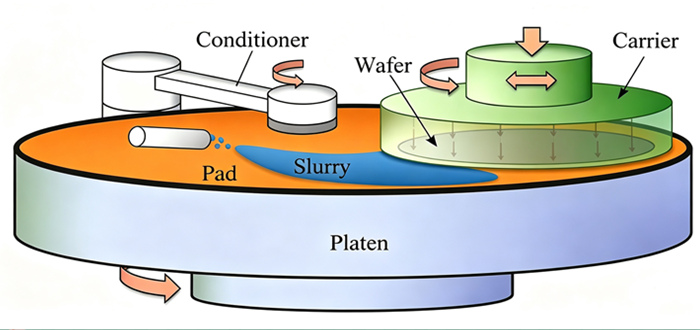
How Does Pad Hardness Affect the Polishing Process?
The effect of pad hardness can be understood through a simple process:
Pad Hardness → Pad Deformation → Contact Behavior → Pressure Distribution → Material Removal → Surface Finish
When pressure is applied during polishing, the pad deforms and creates contact with the workpiece.
A harder pad generally resists deformation more strongly, while a softer pad deforms more easily and can conform more closely to the workpiece surface.
This difference changes the polishing interface and ultimately affects the finished surface.
Research into polishing pad mechanics and CMP processes has shown that pad mechanical properties can influence contact conditions and pressure distribution between the pad and workpiece. These changes can affect material removal and surface quality.
Harder Polishing Pads: Better Stability and Planarization
A harder polishing pad generally has lower deformation under the same polishing load.
Because the pad is more resistant to compression, it can provide a mechanically more stable polishing interface.
This can be beneficial when the application requires:
* Good dimensional stability
* Surface planarization
* Controlled material removal
* Flat workpiece processing
* Consistent polishing geometry
For relatively flat substrates, a harder pad can help maintain the overall contact structure during polishing.
This is why firmer polishing pads are commonly considered for applications where surface flatness and topography correction are important.
However, a harder pad does not automatically produce a smoother surface.
If the polishing pressure, slurry or abrasive particles are not properly matched, a relatively rigid polishing interface may increase localized mechanical interaction with the workpiece.
Therefore, pad hardness must be optimized for the specific polishing process.
—
Softer Polishing Pads: Better Conformability and Fine Finishing
A softer polishing pad deforms more easily under pressure.
This allows the pad to conform more closely to the workpiece surface and can create a more compliant polishing interface.
Softer pads may be advantageous for:
* Fine surface finishing
* Curved or complex surfaces
* Delicate workpieces
* Applications requiring greater surface conformity
Because the pad can adapt more easily to local surface features, it may provide a gentler contact condition during the finishing process.
However, excessive softness can also reduce the pad’s ability to maintain precise surface geometry.
A highly compliant pad may follow the workpiece surface rather than effectively correcting local height differences.
For this reason, a softer pad is not automatically the best choice for every high-precision polishing application.
—
Pad Hardness and Surface Flatness
Surface roughness and surface flatness are different requirements.
A workpiece can have a very low surface roughness while still having poor overall flatness.
In general, a relatively firm polishing pad can provide better mechanical support for applications where planarization and geometric stability are important.
A softer pad provides greater conformity, which can be useful for fine finishing but may not provide the same level of topography correction.
Therefore:
Flatness requirements may favor a more mechanically stable pad.
Fine surface finishing requirements may favor a more compliant pad.
The optimum balance depends on the workpiece material, geometry and polishing process.
—
Does a Harder Polishing Pad Increase Material Removal?
A harder polishing pad may provide a more stable mechanical interface, which can contribute to efficient material removal in some polishing processes.
However, it is not accurate to say that:
> A harder polishing pad always provides a higher material removal rate.
Material removal is also affected by:
* Abrasive type
* Abrasive particle size
* Slurry concentration
* Chemical activity of the slurry
* Polishing pressure
* Relative speed
* Pad surface structure
* Pad conditioning
For example, a pad with suitable porosity and slurry transport characteristics may perform differently from another pad with similar hardness.
Therefore, hardness should be considered together with the complete pad structure.
—
How Does Pad Hardness Affect Surface Roughness?
Pad hardness can influence how abrasive particles interact with the workpiece.
A harder and less compliant pad may maintain a more rigid polishing interface. Depending on the abrasive system and polishing pressure, this can change the mechanical force acting on the workpiece surface.
A softer pad can deform around local surface features and particles, creating a more compliant contact condition.
For fine polishing, this can be useful when the goal is to reduce aggressive mechanical interaction and improve surface quality.
However, surface roughness is also strongly affected by:
* Abrasive particle size
* Particle shape
* Particle agglomeration
* Slurry cleanliness
* Polishing pressure
* Pad surface condition
* Workpiece material
For this reason, changing pad hardness alone may not solve a surface roughness problem.
—
Pad Hardness and Scratch Control
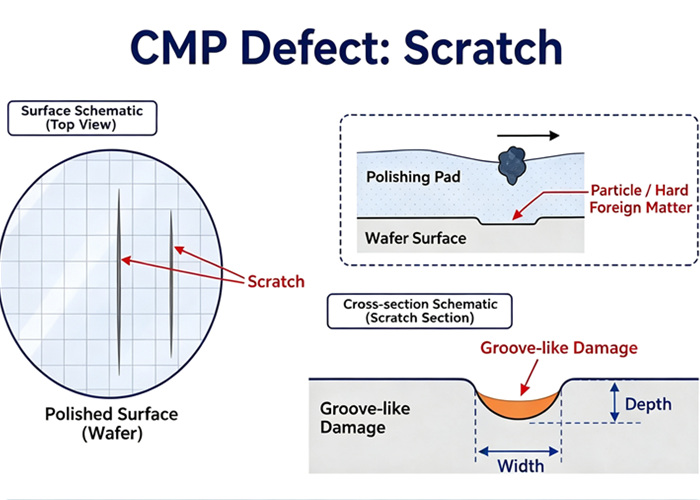
Scratch formation is one of the most important concerns in precision polishing.
Pad hardness can influence the mechanical conditions at the polishing interface, but it is not the only cause of scratches.
Common factors include:
* Oversized abrasive particles
* Particle agglomeration
* Slurry contamination
* Polishing debris
* Excessive pressure
* Pad glazing
* Poor pad conditioning
A harder pad may create a more rigid contact condition, while a softer pad may provide greater local deformation.
However, using an excessively soft pad is not necessarily the best solution for scratch reduction.
The polishing pad must be matched with the correct abrasive particle size, slurry filtration and polishing parameters.
Common polishing pad constructions include:
— Polyurethane Polishing Pads
Polyurethane is widely used because its formulation can be adjusted to achieve different combinations of hardness, wear resistance, elasticity and porosity.
PU polishing pads can therefore be designed for different polishing stages and materials.
–Non-Woven Polishing Pads
Non-woven pads typically provide a more compliant structure than dense polyurethane pads.
Their polishing performance is influenced by fiber structure, density, resin bonding and surface condition.
They can be useful in applications where conformity and controlled finishing are important.
Composite Polishing Pads
Some polishing pads use multiple materials or layers to combine different properties.
For example, a pad structure may provide mechanical support from one layer while using another layer to create a more suitable polishing surface.
This approach can help balance:
* Pad stability
* Surface conformity
* Slurry retention
* Wear resistance
—
Hardness Is Not the Same as Compressibility
This is an important point when selecting a polishing pad.
A pad can have a certain Shore hardness but still behave differently under continuous polishing pressure.
Hardness describes resistance to indentation under a specific test condition.
Compressibility describes how the pad changes in thickness or volume under load.
Elasticity and viscoelasticity describe how the material deforms and recovers over time.
Therefore, hardness alone cannot fully predict polishing performance.
When selecting a polishing pad, it is useful to evaluate:
* Shore hardness
* Compression behavior
* Recovery
* Density
* Porosity
* Surface texture
* Wear resistance
Together, these properties provide a more complete picture of how the pad will behave during polishing.
—
Hard vs. Soft Polishing Pads: Quick Comparison
| Property |
Harder Polishing Pad |
Softer Polishing Pad |
| Deformation under load |
Lower |
Higher |
| Mechanical stability |
Higher |
Lower |
| Surface conformity |
Lower |
Higher |
| Planarization capability |
Generally stronger |
Generally lower |
| Adaptability to complex surfaces |
Lower |
Higher |
| Contact behavior |
More rigid and stable |
More compliant |
| Fine finishing potential |
Process dependent |
Often advantageous |
| Geometry correction |
Often advantageous |
May be limited |
These differences are general tendencies rather than absolute rules.
The actual polishing result depends on the complete polishing system.
—
How to Choose the Right Polishing Pad Hardness
Instead of asking:
Should I use a hard or soft polishing pad?
Consider the following questions:
What material are you polishing?
Glass, sapphire, ceramics, silicon, metals and other materials may require different pad characteristics.
Is surface roughness or flatness more important?
A process focused on planarization may require different pad properties from a process focused on final surface finishing.
What polishing slurry or compound are you using?
The abrasive type and particle size must work together with the mechanical characteristics of the pad.
What is the workpiece geometry?
Flat substrates and complex-shaped components may require different levels of pad conformity.
### What polishing stage is being performed?
Different pads may be used for:
* Material removal
* Intermediate polishing
* Fine polishing
* Final finishing
In some applications, using different polishing pads at different stages can provide a better balance between productivity and surface quality.
—
Conclusion
Polishing pad hardness has a significant influence on surface finish because it affects pad deformation, contact behavior and pressure distribution at the polishing interface.
A harder polishing pad generally provides greater mechanical stability and can be advantageous when surface flatness, geometry control and planarization are important.
A softer polishing pad provides greater conformity and can be beneficial for fine finishing and applications involving curved or delicate surfaces.
However, hardness alone does not determine polishing performance .
The final surface finish is also affected by:
* Pad material and structure
* Compressibility and elasticity
* Porosity
* Polishing slurry
* Abrasive particle characteristics
* Polishing pressure
* Workpiece material
* Pad conditioning
The best polishing pad is therefore not simply the hardest or the softest option.
It is the pad that provides the right balance between mechanical stability, conformity, material removal and surface quality for the specific polishing application.

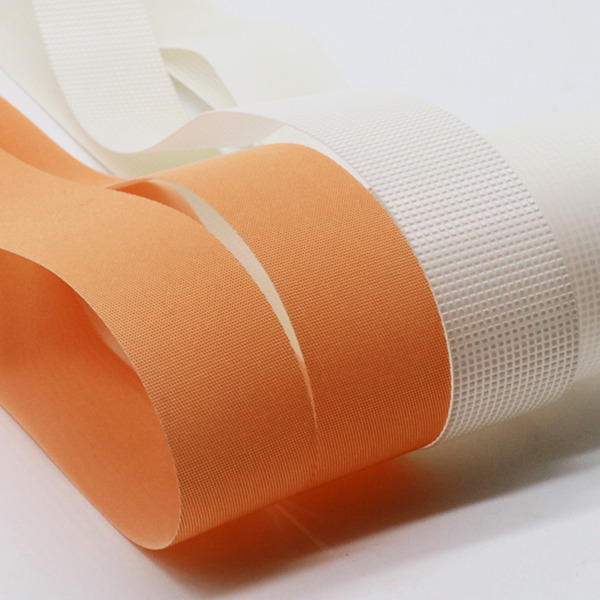 3D Structured Film (Cleaning belt for LCD panels)Flocked Pile Polishing Film for Roller Finishing and LCD Wiping
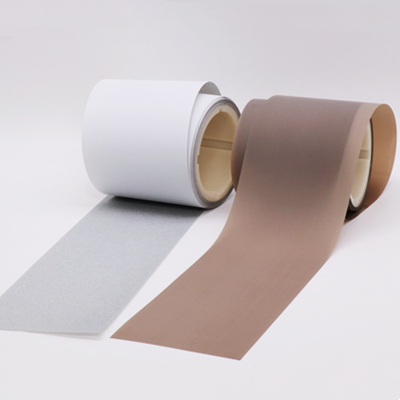 Polishing tape for repair defects and flatten protrusion points in LCD color filter process
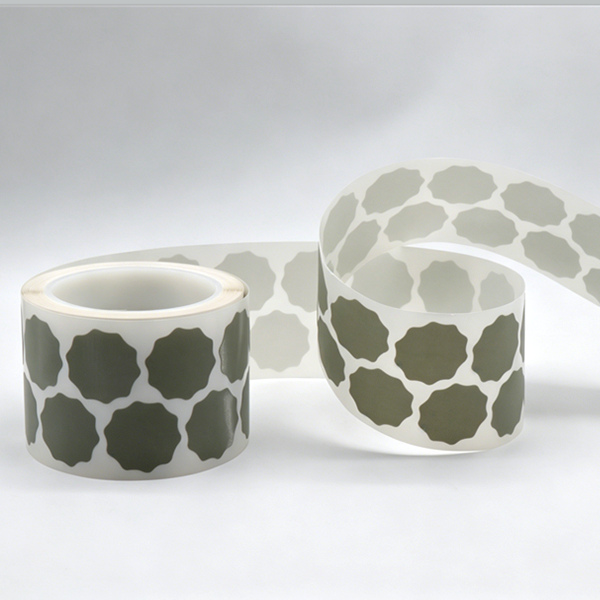 PSA Film Disc Roll for Fine Sanding and Finish of Automotive Coatings
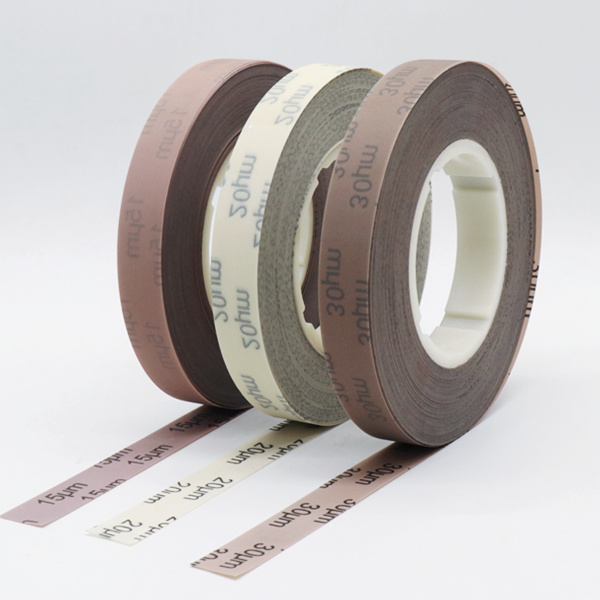 Electrostatic Coated Microfinishing Film Roll for Ultra-Fine Surface Finishing
 Precision Coated Diamond Roll for Fiber Optic & Microfinishing